Understanding Flow – Part 3 Intelligent Spontaneity
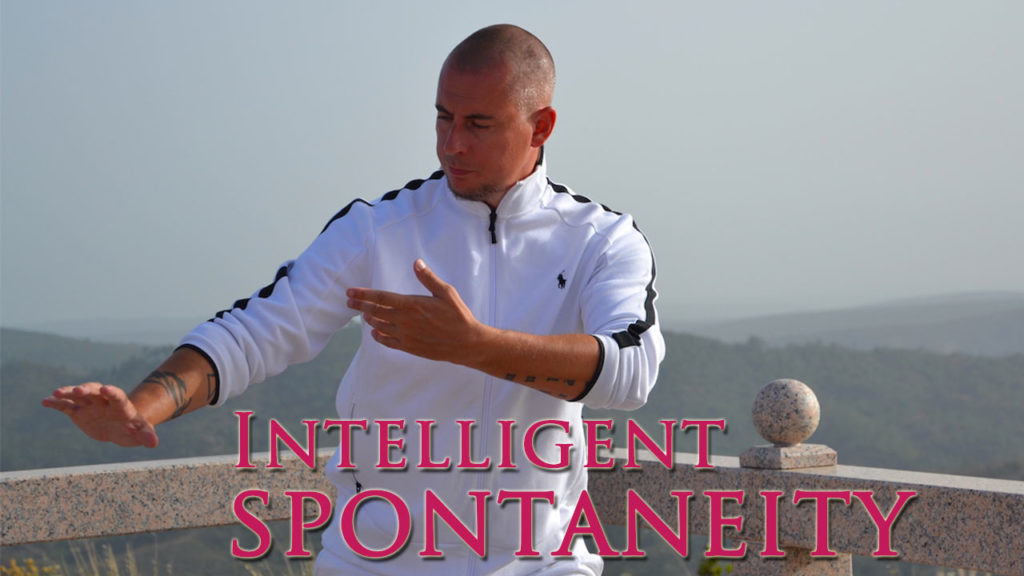
Understanding Flow – Part 3 Intelligent Spontaneity The story of Cook Ting is about how we effectively move through the world with skill and not feel resistance. Reaching your optimal potential is also the same, meaning you attain expert skill in your desired craft and that extends into life in general. This feeling of effortlessness, or flow and wu-wei, is a state of psychological ease we feel through our whole body. The goal of wu-wei, then, is to effectively move smoothly through all aspects of your life, where even unexpected events in your life are dealt with spontaneously with intelligence. No obstacle is too big or even really perceived as an obstacle anymore. In a state of wu-wei you don’t press up against obstacles, but instead you act in the same fashion as the gentle key trying to open the door, which means you may absorb the pressure of an obstacle but because you don’t resist it you overcome it without forcing the outcome. This absorb and action technique is one of the foundational pillars of traditional martial arts. Modern martial artists, especially mixed martial artists, often use the word flow. It is used when someone appears to be very lucid and in the zone. Yet, as I mentioned, common understandings of the concept flow are at a novice level and this goes for a lot martial artists. The spontaneous nature expressed through us in a state of wu-wei is the deeper and more powerful raw material of our hot cognition functioning optimally. When there is no interference from the over-analytical cold system, you express the spontaneity of human nature intelligently. Intelligent spontaneity, then, is a fully embodied state of mind where one is perfectly calibrated to the environment. The environment essentially becomes an extension of your skill. For example, when you are in a state of intelligent spontaneity in martial arts you are perfectly calibrated to the obstacles you face with an opponent. The opponent will try everything to land a blow but you see it almost in slow motion, like Neo in the Matrix. As a result, you act spontaneously without it feeling like a reaction because there was no conscious thought driving it. And even if you do absorb a blow you move with it, which is a technique in the Korean martial art Hapkido. This technique makes the opponent overextend and lose balance, where they usually fall to the ground. In ancient Chinese thought this approach is explained by the concepts yin which is a Chinese word for the feminine and passive energy of the universe and yang which is a Chinese word for the masculine and active energy of the universe. In Chinese thought yin nourishes yang. This means that when we are intelligently passive, or have poise in other words, we give birth to correct action minus aggression. This is a key point, correct action minus aggression. We overextend in Hapkido, or in any martial arts and life in general, when we are full of aggression and emotions. Essentially, if we are not receptive enough we will be hard and rigid. And someone hard and rigid is easily overcome by someone who is soft and flexible because they have poise and are fully present in the moment. As Bruce Lee once said, “Be like water my friend.” This effortless cognitive style is similar to the movements of a graceful dancer. Intelligent spontaneity is not only the effect of a dancer being perfectly calibrated to the environment, but it is also the essential goal of martial arts, or any skill for that matter. In a state of intelligent spontaneity we approach life with a mind of no deliberation. An expert craftsman embodies this effortless state of mind. The craftsman integrates the two systems into mind-body holism. As a result, they are perfectly adapted to the world around them. But, to cultivate expert skill and skill in life, we have to understand how a craftsman disengages from the cold system to allow the hot cognitive virtues of nature to spontaneously flower. The expert craftsman is a perfect example of how both systems function together to evoke intelligent spontaneity. Their mind absorbed in their craft is a metaphor for how we too can be absorbed fully in life through a chosen skill. A skilled craftsman’s integration of mind and body back into its original holism is the result of years of training their embodied cognition to be as natural as nature itself. The craftsman moves effortlessly through their skill and this is applied to life in general. When the two systems function naturally in harmony you will be perfectly calibrated to the environment. This integration of both systems means that the mind is embodied and the body is mindful. To make the two systems integrated and working together harmoniously, we need to develop the ability to concentrate for extended periods of time. This will eventually evoke a deep level of focus that arises from the hot system. A skilled craftsman can evoke this ability spontaneously anytime if it is needed, to the extent that it is as normal as chewing food. The way the process begins is through the long and arduous training which is required to call on a skill upon command. The process of learning a skill to this heightened degree is dependent on a strong cold system to begin with. A strong cold system is dedicated to the theory of a particular skill and the discipline required for it to become embodied. We have all tried to get better at something which requires practice every day. Usually we don’t want to use a lot of effort but something inside says “stop being a weakling. Suck it up and push forward.” That inside dictator is of course the cold cognition, and it is a strong cold cognition if the message is taken on board to push forward. When a craftsman strengthens
Understanding Flow – Part 2 Ancient Philosophy
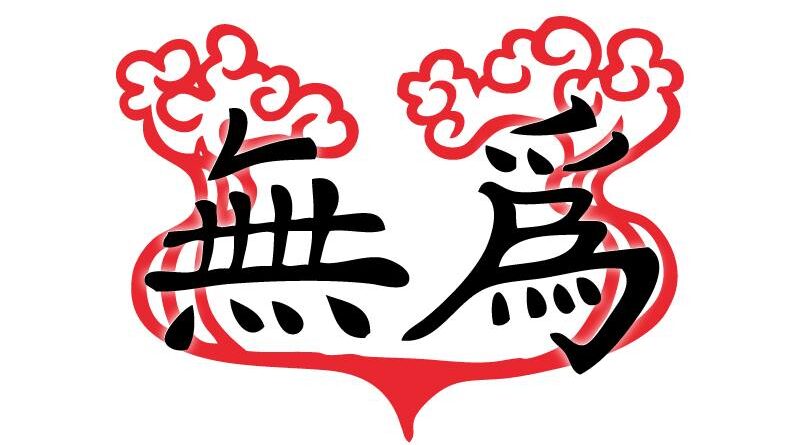
Understanding Flow – Part 2 Ancient Philosophy The embodied model of the self was the primary viewpoint during the Warring States period of China, and also other parts of Asia. But it was in China especially that we discover the embodied mind model. During the Warring States period there were numerous philosophers and sages whose names we still know today. Most notably Lao-tzu, Confucius, Mencius, and Chuang-tzu. Though their philosophies may somewhat differ, their way for understanding the mind and body was the same. Their view of human nature was mind-body holism. Their philosophies, social systems, religions, and ritual practices reflect this holistic view. From centuries of ancient Chinese people following their philosophies and rigorous training to cultivate harmonious dispositions in the self, there is no doubt according to them that human cognition is embodied. Any other model, such as mind-body dualism, was shown the contempt it deserved. If in ancient China the embodied model of the self was understood to be how humans are hardwired, then we can see why a healthy skepticism developed towards mind-body dualism and its idea of a rational agent in control of an unruly body. In the East, in general, this skepticism shown towards rationality is culturally held firm. The battle within us, then, is not between a rational agent attempting to lord it over an unruly body. But instead it is a tug of war between an allocation of function between the two systems of hot and cold cognition. In the West and modern developed world, majority of our energy is allocated towards the function of the cold system trying to control the natural hot system. But in the ancient East it is absurd to try and overemploy the cold system, especially when you consider the main driving force within us and our essential nature is within the hot system. The focus in ancient China, then, was more about ingrained skill and shaping our character because they can both be cultivated in our hot system as natural and spontaneous. Eastern thought, then, especially the ancient Chinese embodied model of the self, is an essential corrective to the way modern Western philosophy has a tendency to focus on the cold cognitive aspects of conscious thought, rationality, and willpower. As a result, the modern revolution of embodied cognition in cognitive science was inspired partially by Eastern thought, especially ancient Chinese thought. The main focus of many ancient Chinese sages and philosophers during the Warring States period was the concept wu-wei. Wu-wei literally means non-doing, non-force, and effortless action. The effortlessness of wu-wei is ultimately a state of intelligent spontaneity. And I believe intelligent spontaneity is a more accurate term than flow when we are talking about that effortless state of mind. Keep in mind though that how wu-wei is achieved differed slightly among each philosopher and sage. Chuang-tzu’s focus was on effortless skill, or in other words effortless action, which actually adapts perfectly to modern cognitive science. We can understand the effortlessness of wu-wei when we think of those times we try too hard to achieve something. When we are trying too hard to achieve an outcome we are not allowing for life to naturally happen. For example, when we put a key in a lock and try to turn the key too fast we feel resistance. To open the door you need to be loose and relaxed and when you jiggle the key ever so softly the door opens effortlessly. By not forcing you effortlessly move through the task of opening a door. The key and door analogy is not only about how expert skill is effortless, but it is also a metaphor for how we move skillfully through life. No other sage or philosopher during the Warring States period explores skill more than Chuang-tzu. The Chuang-tzu text is like a manual for cultivating skill and training spontaneity, upon a lot of other wisdom about life. And this is why Chuang-tzu synthesizes well with modern cognitive science. The skill emphasized by Chuang-tzu in the Chuang-tzu text is not only about expertise, but also life skills which are supposed to contribute to developing harmonious dispositions in the self. Chuang-tzu, on a subtle level, examines the science of skill and how to reach peak performance to the point of explaining what the actual experience is like. Chuang-tzu understood that spontaneous skill comes from the deeper, more evolutionary ancient hot system. Somehow we need to ignite the spontaneity within the hot system naturally without any effort to do so. The cold system interferes with the spontaneity of life. Even in ancient China people overly identified with the cold system which gives one this sense of being an isolated self. Chuang-tzu explains that our real nature, the authentic self, is beneath the rational cold cognition. He articulates this through skill stories that exhibit this transfer of functional allocation from the cold system back to the hot system. He uses the craftsmen as an example to explain how skill and virtues can become so much a part of us that they are instinctive and spontaneous, they are hot. One of the most famous stories in the Chuang-tzu text is about a butcher called Cook Ting (or Butcher Ding). The Cook Ting story setting is a traditional religious ceremony where an ox will be sacrificed in public for the ruler Lord Wen-hui and a large crowd of onlookers. Cook Ting is the center of attention for this religious event. This ritual of animal sacrifice demands the difficult skill of using a blade with precise timing and perfect execution. But this is not a difficult task for Cook Ting. He slices and dices the ox up so effortlessly that Lord Wen-hui is astonished. Lord Wen-hui cannot believe such a mundane skill can reach the heights of beauty similar to an artistic performance. He approaches Cook Ting to ask how he can
Understanding Flow – Part 1 Modern Science
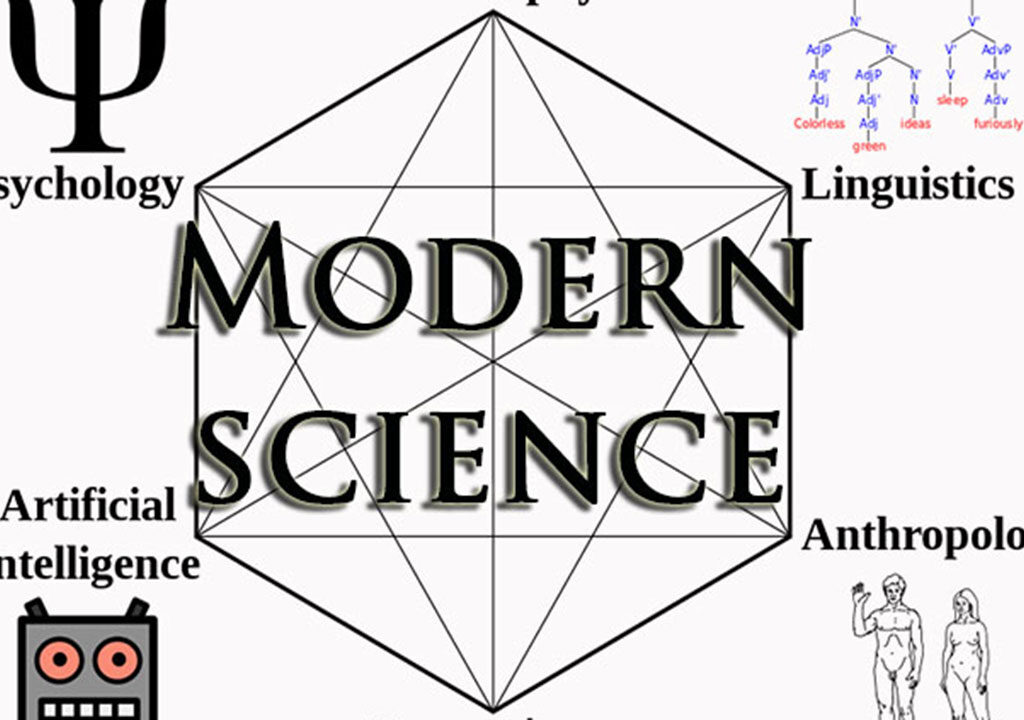
Understanding Flow – Part 1 Modern Science What is the nature of being in a flow state of consciousness? How and why do we experience flow? What truly is flow? The term flow was first coined and popularized by Mihaly Csikzentmihalyi who is a Hungarian psychologist. He wrote a fascinating book called Flow back in 1990. When we think of flow we think of an athlete, musician, writer, craftsman, or any artist when they appear to have this laser-like focus and precision which is equated with them being in the zone. But flow is a much more ancient concept going back to the Warring States period of China (475-221 BCE). Its original ancestor is known in Chinese as wu-wei, which is a concept at the heart of Taoism and martial arts. Many of us are familiar with the term flow but not with wu-wei. Understanding wu-wei and the Eastern mind it came from, is imperative for us to truly understand the depth of flow. Yet, in the modern day, our understanding of flow and how to induce it is at a novice level. The word is loosely thrown around in popular culture. We hear people proclaim that “they’re in the zone,” or more to the point “I’m in the zone” or “I’m in the flow,” which actually implies you’re not in any state of flow if you have time to speak about it. We often hear athletes state after a great performance how they felt they were in a state of flow, where all the external noise of the world was eliminated. They essentially had tunnel vision. To be highly effective at our chosen skill we need to enter a flow state of consciousness. But the problem for most of us is we have no idea how to enter a flow state. Many of us incorrectly believe this dimension of effortless skill and peak performance is a state of mind isolated to world-class performers. You need to eliminate this way of thinking and really absorb the information I am about to give you. First and foremost, cultivating skill and reaching peak performance, in other words entering a state of flow, really depends on how we understand the mind and body. This is not some new radical way of thinking. This was actually the primary focus of numerous great thinkers throughout history. It doesn’t matter whether East or West, understanding human thought and the minds function has been a central focus for as long as we can remember. We’ve always been fascinated with why cultures and traditions developed, why certain religions were born to bind community, and why someone is more skillful at a particular craft than someone else. The process of thinking and how and why we think is at the foundation of philosophy, science, religion, and art. For thousands of years, both in the East and West, there have been numerous systems for understanding the mind. Some have stuck and many have disappeared. But for as long as we can remember there has been a persistent myth pervading human civilization: mind-body dualism. This dualistic model of mind and body has become the standard template for which we study the mind and the body. As a result, it is common for us to feel this split within us, which is evident in our language and actions. This dualistic model of mind and body is the big reason we don’t understand the nature of flow. We tend to feel we are these rational minds in these completely irrational bodies. Mind-body dualism is the disembodied myth embedded in our modern thinking. This myth has led us to focus and believe firmly in an abstract rationality, where reason trumps all. So we end up believing we are these disembodied rational agents imprisoned within this meat suit we call a body. The disembodied myth is a philosophical hangover from Plato down to influential philosophers such as Descartes and Immanuel Kant. Philosophers such as these three propelled the dualistic model of mind and body along based on vague intuitions they had about a distinction between people who have minds and the physical world, which apparently doesn’t have a mind according to them. Their metaphysics led to a dualism between a disembodied mind and a physical world of things. In post-Enlightenment Europe and its colonies rational thought was portrayed as the essence of human nature. Reason became something completely disconnected from the physical world around us. Our mind, and its rationality, is thought to be superior and distinct to the body and its emotions. The disembodied myth has implanted a split within us that confuses us to no end. We have bought into the disembodied model of mind without questioning its validity. Science also has been handicapped by the disembodied model. Cognitive scientists in the mid-twentieth-century treated the human mind as a brain in a container. Many experiments were concerned with abstract information processing which led them nowhere. It wasn’t until the past few decades that cognitive science began to change its perspective. Cognitive science is slowly moving away from the disembodied dualistic model and instead is beginning to treat human thought as fundamentally embodied. Cognitive science has shown through extensive research on embodied cognition that we are not the paragons of reason we assume to be. Though, science is just catching up to this perspective. Many sages, artists, philosophers, and even athletes have questioned the overuse of rationality, as the actuality of their experience tells another story. This also might be why many artists, writers, and philosophers are usually considered as having eccentric behavior by the general public. Many sages from the East, on the other hand, are often suspicious of rational people because rational people often think too much about everything. An artist would say being overly rational destroys beauty and truth. Ask yourself what is rational about a lot of art? Or even for the
Best Books for Studying Yoga
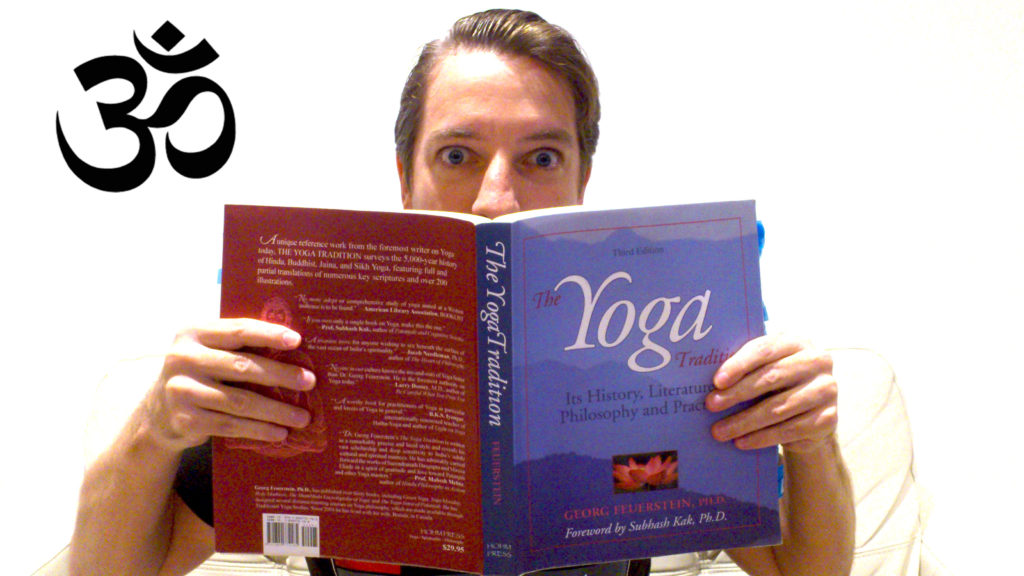
Best Books for Studying Yoga I find it disappointing that when most people hear the word “yoga” they think of an exercise routine that is focused on stretching the body, making one more flexible. I’m sorry to be the bearer of bad news, but that’s not yoga. That idea of yoga results from the cultural appropriation it went through when it went to the West, especially in places such as America. That version of yoga is a poor replica of the traditional hatha yoga which is only one branch of yoga. Actually, there are seven main paths or temperaments of yoga known in Sanskrit as hatha, mantra, tantra, karma, bhakti, raja, and jnana. Yoga is not asana and in actual fact the word asana literally means to sit or seat, revealing that the first yoga posture is sitting meditation. So, yoga is not an exercise routine where we wear skimpy tight clothes which is all too egocentric. Real yoga is about dissolving those tendencies to be egocentric, which includes our urge to be physically attractive. Yoga is a system of knowledge designed to liberate you from the idea of an isolated and separate ego so that you can reunite with the divine. The word yoga comes from the Sanskrit root yuj which means to yoke, unite, or join with the absolute Ultimate Reality (Brahman) beneath all the energy and movement of duality in the universe, known as prakrti in Sanskrit. At its core, then, yoga is a dualistic philosophy where we are supposed to break free of the gravitational pull of all the energy, including thoughts, and movement in the universe (prakrti). The way this is done is by coming back into resonance with your innate pure awareness (purusha in Sanskrit) which unites you with the Ultimate Reality, Brahman. Pure awareness is the root of our consciousness and the main principle of all forms of yoga. Patanjali, the founder of classical yoga, believes that the evolutionary aspect of mind, citta in Sanskrit, is to refine our mind back into its original state of pure awareness. Our mind (citta) is wound up in the vortex of energy and movement in the universe (prakrti). The goal of yoga is to unravel our mind from this turbulence. This is done by coming back into resonance with pure awareness, where it is said that eventually you will develop a gap between prakrti and Purusha, meaning you will be able to look on the world of form from a distance without being moved by the activity of the world. This is liberation in yoga and what all honest yogini’s and yogi’s should be striving to achieve. I will recommend the best books for you to achieve this liberated state and to further your understanding of yoga, and also how to apply it to your life. To build a foundation for understanding yoga I suggest first reading The Yoga Sutras of Patanjali. This is the foundation of yoga from the great master Patanjali. In an ideal world, I always say that it is best to read the classics first to get your head around the actual philosophy and practice. The Yoga Sutras of Patanjali is no different and I class it as one of the greatest classical texts on the planet (definitely top five). There are so many translations on the market and a lot of good ones. But I will give you my personal favorites. My favorite translation is by Chip Hartranft. His translation of The Yoga Sutras of Patanjali is translated for the modern mind but keeps its ancient beauty. I’ve read his version many times and it always plunges me deeper to reveal more about the nature of self and the universe. The second translation I recommend is by Swami Satchidananda. His translation of The Yoga Sutras of Patanjali sticks more to tradition but is very lucid and profound. It really is a showcase of how great Swami Satchidananda really was. He was one of the most honest and brilliant gurus to have graced our earth in recent history and his translation reflects his greatness. These two translations are even better when they are coupled together. Outside of The Yoga Sutras of Patanjali, the most important book on yoga is The Yoga Tradition by Georg Feuerstein. Georg Feuerstein is the greatest scholar and teacher of yoga you’ve never met or heard of. A lot of his work is criticized because of how intelligent and scholarly his writing was. But he should not be criticized for the genius he was. Actually, the onus and responsibility is on the reader is to be more intelligent and that can come about by reading his works (also criticizing someone highly intelligent because you can’t understand is an act done by those less intelligent). As for yoga, all of his works are unmatched. Even his translation of The Yoga Sutras of Patanjali is brilliant. But it is The Yoga Tradition where his knowledge and wisdom really shines. As a writer, when I read The Yoga Tradition I am in awe of how he could have wrote such a tome. In this book, Feuerstein takes you through the whole history of Hindu thought, not just yoga. He explores Vedanta, Samkhya, Jainism, and Buddhism in relation to yoga, which gives you the full scope of Indian thought. Though, if you do take the challenge and read this book you better be prepared because it is a behemoth. This is why it is sometimes referred to as the “yoga phone book.” But if you are serious about yoga then this book cannot be avoided. And you won’t regret it because it is full of insights and traditional knowledge on yoga. Another book I recommend is by Feuerstein again. It is called The Psychology of Yoga. You should read this book after The Yoga Tradition. It was the last book Feuerstein wrote before he passed away in 2012.
GO BEYOND EVERYTHING
In this episode of Enlightenment Today I will explore what it means to go beyond everything and essentially going all the way. This is the spiritual ideal of the great Eastern spiritual traditions and sages. But this ultimate goal is something that frightens most people because they are not willing to truly give up their sense of self. People who become interested in spirituality forget this ideal because people often subtly use spirituality to propagate their ego rather than dissolve it. Going beyond everything means you’ve come into resonance with the underlying witness of all life.
The Art of No Debate
In this episode of Enlightenment Today I will explore the Eastern resistance to debating, especially in countries such as Japan. Avoiding debate is another hallmark of Eastern thought that a lot of Westerners find hard to comprehend. In the West we are almost encouraged to debate so we can come to a conclusion on a matter. This way of thinking is incorrectly believed to be universal. Westerners often think that the way they think is the same for everyone else. This is a clumsy way of viewing the world. Both East and West cognitively evolved differently which influenced their social structures, philosophies, religions, language, and basic world view. In the West debate was a natural byproduct of analytical thinking and individualism. While in the East, avoiding debate was a natural byproduct of holistic thinking and collectivism.
Spiritual Materialism
In this episode Enlightenment Today I will explore spiritual materialism. I’m going to explain why people feel the need to show their spirituality on the outside. This means that I’m going to put under the microscope all of our dreadlocks, tattoos, piercings, and other accessories.
Footsteps of the Himalayan Yogis Nepal Tour 2019 with Jason Gregory
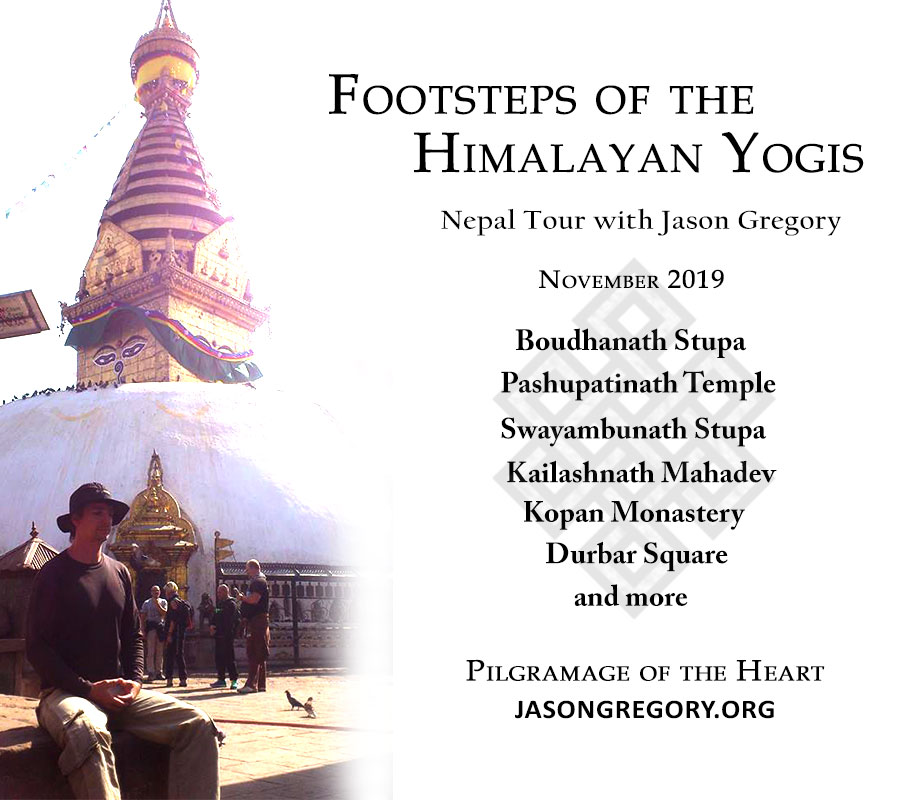
FOOTSTEPS OF THE HIMALAYAN YOGIS NEPAL TOUR with Jason Gregory 16-25 NOVEMBER 2019 The Footsteps of the Himalayan Yogis Nepal Tour is one of the most unique travel experiences in the world. You can travel with author, philosopher, and spiritual teacher Jason Gregory on a mystical tour of Nepal to explore and trace the footsteps of the Himalayan yogis. Get unique insights into Jason’s knowledge of the East and the memory of the masters and scared places you will visit. Jason wishes to take people to the most sacred places in the sacred Kathmandu valley to show that the ancient Hindu and Buddhist cultures are thriving. But this can only be experienced by those willing to join him on this pilgrimage of the heart. 1. About the tour of Nepal: Our 10-day itinerary includes visits to the most breathtakingly beautiful and mystical places of the Kathmandu Valley in Nepal. We will travel through Nepal to visit the most important sacred places of Nepalese history. Most people never get the chance to experience face to face the archaic origins and sacred sites of Hindu and Buddhist culture. But on this journey you will get a once in a lifetime opportunity to actually feel the ancient living culture that is still thriving in the sacred places you will visit. You will also get the chance to meet real life mystics and mingle with the beautiful people of Nepal. What is more, during the tour you will take part in private discourses given by Jason Gregory. He will show you the significance of how the great Eastern spiritual traditions can help you live more harmoniously in the modern world. You will begin to understand the deep wisdom the mystics of the East expounded for you to find true happiness and fulfillment in this life. And this is the reason for joining Jason Gregory on his tour of Nepal to follow the Footsteps of the Himalayan Yogis. This is a once in a life-time experience! Jason Gregory about the Nepal tour: “I have spent several years in Nepal and the experience has changed the entire course of my life. I continue to go back and visit every year. One of my favorite places in the world is the sacred Kathmandu Valley. The Hindu and Buddhist pilgrimage sites in the Kathmandu Valley are some of the most powerful and peaceful you will visit in the world. There is something magical about being in the Himalayas that the ancient Hindus and Buddhists understood. The mountains have a mystical presence that have attracted mystics for thousands of years. This is why the Kathmandu Valley is significant, as it is in the heart of the Himalayas. And luckily for all those on tour, we will be in this heart of the Himalayas that the mystics believed to be sacred. I have always told people that Nepal is hard to explain, the attraction people have to it, and its transformative ability on an individual. It is a place full of color, where the culture is vibrant and the people humble. Kathmandu Valley is a unique blend of past and present. My life in Nepal has not just been transformed by their ancient spiritual traditions, but also from the humble nature of the people and beautiful culture. This spiritual essence you experience in Nepal comes from thousands of years of people focused on the inner realm of spirituality that has led to many great sages and stories of enlightenment in the Himalayas. On this tour, I want to allow people to experience this living spirit that we feel when we are in the culture of Nepal by following the footsteps of the Himalayan Yogis. My experience of living in Nepal for several years allows me to take you on an insider’s journey of Nepal on this tour, where you will come face to face with the Himalayan soul. Plus you’ll also have a lot of fun, fun like you’ve never had before.” 2. ITINERARY Day 1 – Arrival to Kathmandu (16 November 2019) Arrival at Tribhuvan International Airport in Kathmandu. A representative of the tour team will welcome guests at the Tribhuvan International Airport and transport them to the hotel. After the check-in process at the hotel, guests will have time to rest and recuperate while all guests arrive at the hotel. Day 2 – Boudhanath & Pashupatinath Temple (17 November 2019) On day 2 we will explore two of the most sacred sites for Buddhists and Hindus in the Kathmandu Valley. In the morning we will visit Boudhanath, one of the largest spherical stupa’s in the world because of its massive mandala. The Boudhanath Stupa is a sacred place of pilgrimage for Buddhists. We will circumambulate the stupa many times in meditation. Later we will enjoy all the wonderful shops and culture that are thriving in Boudhanath. In the late afternoon we will visit the famous Pashupatinath Temple located along the Bagmati River. This is a very sacred temple for Hindus and considered the most sacred place in Nepal. The temple serves as the seat of Nepal’s national deity, Pashupati, who is an incarnation of the Hindu god Shiva. We will explore the temple complex, visiting the ritual cremation ghats and also the many sadhus along the banks of the Bagmati River. In the early evening we will attend the Pashupatinath Bagmati Aarti, a sacred Hindu ritual performed along the banks of the Bagmati River. Day 3 – Bhaktapur Durbar Square (18 November 2019) On day 3 we will travel to the ancient city of Bhaktapur and visit the famous Bhaktapur Durbar Square. Bhaktapur is the largest of three Newar kingdoms, the other two kingdoms are Kathmandu and Patan. All three are the home to a Durbar Square (royal palace), but Bhaktapur Durbar Square is the most impressive. It actually consists of four distinct squares (Durbar Square, Taumadhi Square, Dattatreya Square and Pottery Square). It has Hindu and Buddhist iconography scattered all throughout the complex. We will explore this ancient complex all throughout the day. Day 4 – Kopan Monastery & Pullahari
Footsteps of the Masters India Tour 2019 with Jason Gregory
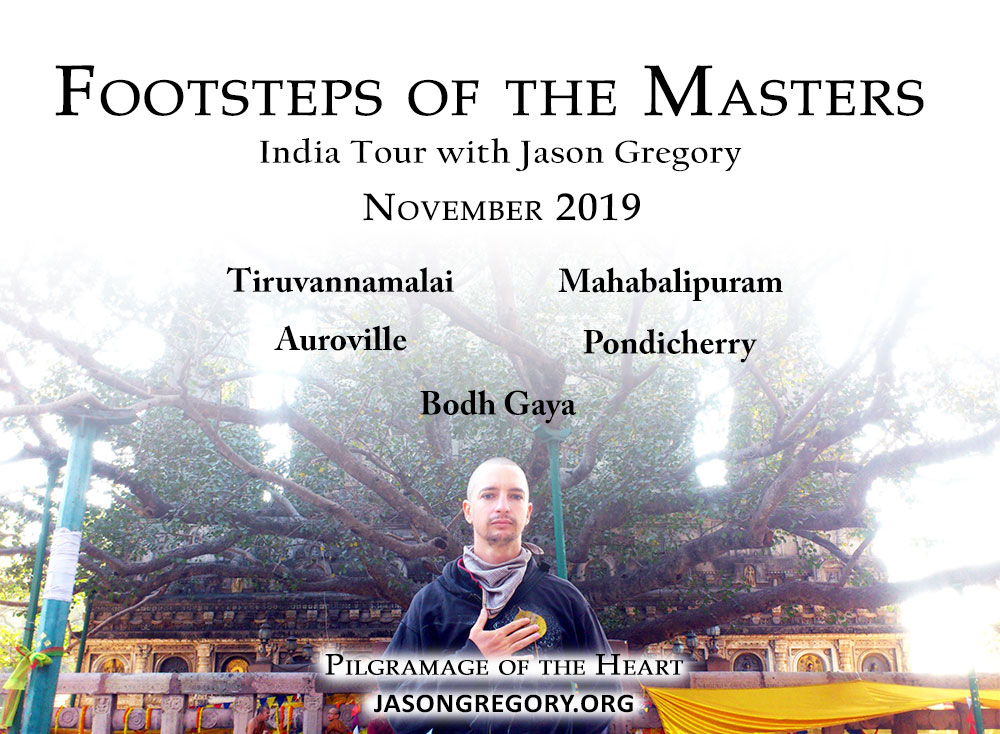
FOOTSTEPS OF THE MASTERS INDIA TOUR with Jason Gregory 1-13 NOVEMBER 2019 The Footsteps of the Masters India Tour is one of the most unique travel experiences in the world. You can travel with author, philosopher, and spiritual teacher Jason Gregory on a mystical tour of India to explore and trace the footsteps of the masters. Get unique insights into Jason’s knowledge of the East and the memory of the masters and scared places you will visit. Jason wishes to take people to the most sacred places of India to show that the ancient Hindu and Buddhist cultures are thriving but can only be experienced by those willing to join him on this pilgrimage of the heart. 1. About our tour to India: Our 13-day itinerary includes visits to the most breathtakingly beautiful and mystical places in India. We will travel through India to visit the most important sacred places of Indian history. Most people never get the chance to experience face to face the archaic origins and sacred sites of Hindu and Buddhist culture. But on this journey you will get a once in a lifetime opportunity to actually feel the ancient living culture that is still thriving in the sacred places you will visit. You will also get the chance to meet real life mystics and mingle with the beautiful people of India. What is more, during the tour you will take part in private discourses given by Jason Gregory. He will show you the significance of how the great Eastern spiritual traditions can help you live more harmoniously in the modern world. You will begin to understand the deep wisdom the mystics of the East expounded for you to find true happiness and fulfillment in this life. And this is the reason for joining Jason Gregory on his tour of India to follow the Footsteps of the Masters. This is a once in a life-time experience! Jason Gregory about the India tour: “I have spent several years in India and the experience has changed the entire course of my life. I continue to go back and visit every year, especially the Tamil Nadu and Bihar states as they are home the two places in the world I believe everybody should visit, Tiruvannamalai and Bodh Gaya, and we will be visiting both places on this tour. I have always told people that India is hard to explain, the attraction people have to it, and its transformative ability on an individual. It is a place that most people dislike from a distance because of real life hardships that people witness in India. But I have always implored people to persevere with her grace because if you can get past all the things that push you out of your comfort zone, there is an underlying essence of spirit that is only found in India, but you need to give her time and be open to new experiences. Many believe this comes from thousands of years of people focused on the inner realm of spirituality that has led to many great sages and stories of enlightenment in India. On this tour I want to allow people to experience this living spirit that we feel when we are in the culture of India by following the footsteps of the masters. My experience of living in India for several years allows me to take you on an insider’s journey of India on this tour where you will come face to face with her archaic soul. Plus you’ll also have a lot of fun, fun like you’ve never had before” 2. ITINERARY Day 1 – Arrival to Chennai (1 November 2019) Arrival at Chennai International Airport. A representative of the tour team will welcome guests at the Chennai Airport and transport them to the hotel. After the check-in process at the hotel, guests will have time to rest and briefly explore Chennai. Overnight stay at the hotel in Chennai. Day 2 – Tiruvannamalai (2 November 2019) Travelling to Tiruvannamalai. Tiruvannmalai is considered one of the most sacred places on Earth. It has the ability to transform one’s life. It is known as the City of Enlightenment for that very reason. It has been the home of sages, sadhus, and yogis for thousands of years. Tiruvannamalai is home to the holy mountain Arunachala, which is thought to be an incarnation of Shiva. Arunachala is what drew the 20th century sage Ramana Maharshi to this little Indian town, where he remained silent for 7 years up on the holy mountain in meditation. During his life on the slopes and at the foot of Arunachala disciples were attracted to his immense presence and an ashram was built around him, the famous Sri Ramana Asramam. It was here that Paul Brunton had his famous encounter with the Maharshi and consequently led to his international bestseller In Search of Secret India. This Hindu culture has never left this place, where you find sadhus descend on Tiruvannamalai every day renouncing the world to be at the foot of Arunachala and to also spend time in meditation at the Arunachaleswarar Temple (Temple of Shiva). During day 2 we will visit Arunachaleswarar Temple (Temple of Shiva) and explore its magnificent architecture and mythology. We will tour the city of Tiruvannamalai to get acquainted with the City of Enlightenment. Day 3 – Tiruvannamalai (3 November 2019) Early in the morning we will go to Sri Ramana Ashram to observe Puja (Hindu ritual worship) and also meditate in the silence of this sacred space. We will then walk up to Skanda Ashram and Virupaksha Cave where Sri Ramana Maharshi spent many years in silence. We will practice meditation in both places. Later in the day we will visit the famous Girivalam Path to visit temples and be in the presence of sadhus. Day 4 – Tiruvannamalai (4 November 2019) We will rise early again on day 4 to walk up Arunachala and visit Skanda Ashram one last time to meditate before we embark on our day. During our last day in Tiruvannamalai we will visit the Sri Ramana
Ramana Maharshi
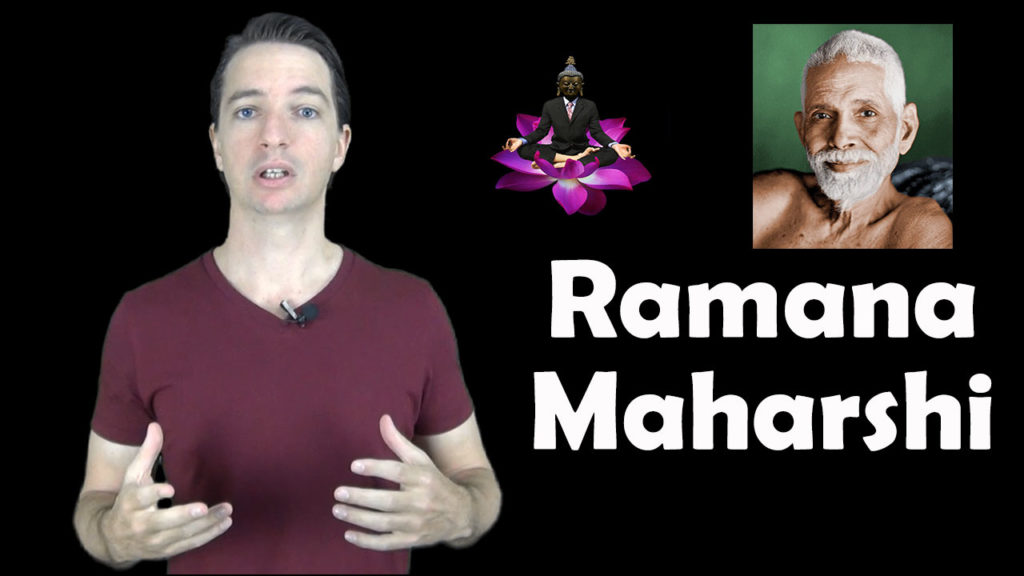
In this episode of Enlightenment Today I will explore the life and teachings of the great 20th century sage Ramana Maharshi. His life was dedicated to the ancient spiritual tradition of Advaita Vedanta (nondualism) after his enlightenment at the young age of sixteen. Ramana Maharshi belongs in the honorable company of the Buddha, Lao-tzu, Chuang-tzu, Shankara, Patanjali, Bodhidharma, and Mahavira. His timeless teachings are imperative to understand in our busy and chaotic modern world. Recommended Reading Be as You Are http://amzn.to/2z1YML6 Who am I?: The Teachings of Bhagavan Sri Ramana Maharshi https://amzn.to/2oIbR8w The Collected Works of Ramana Maharshi https://amzn.to/2Q6nxPd The Spiritual Teaching of Ramana Maharshi https://amzn.to/2oFQzIH NOTE: This site directs people to Amazon and is an Amazon Associate member. As an Amazon Associate I earn from qualifying purchases. The pages on this website may contain affiliate links, which means I may receive a commission if you click a link and purchase something that I have recommended.