The Teachings of Oneness in the Bhagavad Gita Course – Teachable
The Teachings of Oneness in the Bhagavad Gita Course The Teachings of Oneness in the Bhagavad Gita Course is a comprehensive exploration and restoration of the original teachings of the Bhagavad Gita. Rooted in the tradition of Sanatana Dharma, the Bhagavad Gita is demystified in this course, revealing the genuine essence of living in harmony with one’s Dharma. Unfortunately, the deeper teachings of the Bhagavad Gita are often lost due to a warping of the text to suit the philosophical agenda of certain organized groups, no matter whether that warping is based on a dualist view or the ardent focus on devotion. As a result, the original teachings, which are nondual, are misunderstood. The true teachings of oneness in the Bhagavad Gita are usually misunderstood due to the complex cultural aspects of the great scripture. These aspects are not only lost somewhat within India but also inhibit a foreigner’s understanding of the Bhagavad Gita, especially due to the lack of traditional knowledge and values in the modern world. By returning to tradition, in this case to the true nature of Sanatana Dharma (Hinduism), one will begin to comprehend the subtlety of the Bhagavad Gita, which will open the door to a deeper exploration of the nondual teachings within the sacred scripture. Total length of this course: 5 hours Module 1: Introduction to the Bhagavad Gita Explore the key concepts and principles of the Bhagavad Gita from the ancient traditional perspective of Sanatana Dharma. Understanding the traditional perspective and the key concepts and principles will guide us into a deeper comprehension throughout the following modules. Module 2: The Foundations of Yoga in the Bhagavad Gita We will explore the true nature of yoga as we find it in the Bhagavad Gita. I will explain the very ancient yoga far before the Bhagavad Gita that informs the scripture as we traverse the numerous forms of yoga, from the highest yoga to the importance of the yoga of surrender. Module 3: Who is the Hero of the Great War? I will explain the importance of the Kurukshetra War, where the Bhagavad Gita takes place. To understand the importance of this war, we will explore the ancient philosophical teachings of Samkhya and Yoga alongside the traditional cultural systems that help resolve the debate between free will versus divine will. Module 4: Yoga on the Battlefield of Life The Kurukshetra War in the Bhagavad Gita represents a reflection of our own trials and tribulations in life. I will explain in-depth the nature of this battlefield and the path of yoga set out for each and every one of us to be the hero of our own story. Module 5: Transcending the Power of Maya There are many misunderstandings of the concept of maya due to poor translations and a lack of spiritually intuiting the meaning correctly. I will explain what the concept of maya is within the Bhagavad Gita and the practices we need to employ to transcend its power so that we can abide in the oneness of Brahman, which is the Ultimate Reality of existence beyond God. Module 6: Personal and Impersonal Love of the Divine We can often get swept up with our own quest for enlightenment by yearning for the impersonal Brahman and neglect the need for our personal love of the divine through the tradition of the Devatas, which keeps us humbly human. I will explain the Devata tradition and why devotion is important for spiritual growth. Module 7: The Secret Path of Meditation and the Vision of the Divine There is a secret path of meditation in the Bhagavad Gita that is not often discussed, nor is it usually considered one of the generic paths of yoga. But I will explain the concepts and practices of this secret meditation so that we can finally embrace the true vision of the divine, which was an unconventional revelation taught by Krishna that was a truth hard for Arjuna to accept. Module 8: The Ultimate Yoga Beyond the Bhagavad Gita An ultimate yoga reserved for the great sages exists once we comprehend the true teachings of the Bhagavad Gita. I will explain the teachings of this ultimate yoga and why it is a path found by few and only for those who are ready to taste the sweet nectar of the Truth. We will finish the course by having a discussion on everything we have learned in the past four weeks. Price and Schedule Cost is $180 AUD. This one-time purchase plan gives you access to the full content of The Teachings of Oneness in the Bhagavad Gita Course (8 Modules in total), with unlimited viewing for a 3-month period. COURSE REGISTERATION
The Complete Teachings of Taoism Course – Teachable
The Complete Teachings of Taoism Course The Complete Teachings of Taoism Course is a comprehensive exploration and restoration of Taoism. Rooted in the philosophy of nature, Taoism is demystified in this course, revealing the genuine essence of living in harmony with the natural way, the Tao. This course will eliminate all the misunderstanding, misinterpretation, and misinformation that is eroding the essence of the Taoist tradition, creating clarity regarding what Taoism truly is and what it means to be Taoist. Total length of this course: 8 hours 10 minutes Module 1: Reclaiming Taoism Explore Taoism from the ancient Chinese traditional perspective based on the two source texts, the Tao Te Ching and the Chuang-tzu. I will explain why classical Taoism is actually a lot different from how a lot of people think about Taoism today. Module 2: The Metaphysical Framework of Taoism For the first time ever recorded, I will explain the metaphysical framework, all the way from the undifferentiated reality to the manifest world. I go into how that universal unfolding is reflected in our very being, making the human being a reflection of the entire universe. Module 3: Taoism’s Critique of Confucianism and Socialization We will explore how Taoism was actually a critique of Confucianism throughout the Warring States period of China. In doing so, I will dispel a lot of the false views around Confucius and Confucianism. I will explain why Taoism is the real natural system, which goes deep into its critique of how Confucius had this strange belief that by following his rules and regulations, that is what made us natural again. Module 4: The Dissolution of Identity Taoism’s ultimate aim is the dissolution of identity so that the undifferentiated Tao can make use of an individual. This is never spoken about in pop-Taoism for some reason, but from an ancient traditional perspective, Taoism is very similar to other nondual traditions throughout Asia. Though Taoism does differ slightly from the strict nondual traditions, it has a more holistic, integral teaching. I will explain in this module Taoism’s integral nondual approach. Module 5: The Immorality of Morality I will explain the illusion of morality based on the teachings of Chuang-tzu and, as a result, why Taoism is an amoral tradition centered on nature and not governed by man-made morals. No one ever explores the amoral perspective of Taoism because most people don’t know about it or are afraid to speak about it candidly in the face of our moral systems. In understanding the amorality of Taoism in this course, you will have a roadmap to go beyond the illusions of good and evil to come closer to an understanding of true oneness, which is the goal of Taoism. Module 6: The Politically Incorrect Nature of Taoism This module covers the politically incorrect nature of Taoism and why a society stricken with political correctness is unnatural. I will explain some of the deepest, yet misunderstood stories from the Chuang-tzu text so that you can understand the natural amoral perspective of Taoism. I explain that Chuang-tzu himself had to also deal with the politically correct nonsense of Confucianism, as we do too in the modern world. As a result, I will use the teachings of Chuang-tzu to critique the modern politically correct attitude that is infecting innocent people’s minds in the present day. Module 7: Beyond Good and Evil We will explore why Taoism believes our human nature is fundamentally good. In doing so, I will destroy the commonly held assumption that we are beasts from birth. I will explain this by using Taoism to analyze Confucianism, the Abrahamic faiths, and other Western traditions that believe we are beasts from birth. Module 8: The Simple World vs. The Complex World Moving constantly into a complex world is something Lao-tzu and Chuang-tzu warned us about. They knew if we fell for the artificial linguistic conventions and cultural frameworks, it would be hard to wrestle our awareness from these tools of partiality so that we could see the world as it truly is. I will explain in this module the subtle battle between the natural, simple world and the evolving, complex world. We will explore Lao-tzu’s teaching of the two desires and Chuang’s great undoing so that we can attune to the Tao. Module 9: The Art of Doing Nothing The essential Taoist teaching of wu-wei can be a confusing concept for those who are addicted to doing. Modern teachers and students of Taoism are also puzzled by wu-wei, as we discover through many people adapting it to their own sensibilities. We need to understand wu-wei as it is. I will explain the different translations of wu-wei and how in essence all interpretations lead to nondoing. Module 10: The Spontaneous Reality The real world of the Tao is a spontaneous reality. The sage lives in this spontaneous reality. I will explain the nature of this spontaneous reality by delving into the Taoist concept of tzu-jan (naturalness), the illusion of thinking, mind seeking, and the hidden teaching of what thoughts would be without language. I will expand this knowledge through an exploration into the concept of the unsupported thought and how the unconscious linkage of thoughts create the identity. Module 11: Free and Easy Wandering in Oneness I explain the ultimate teaching after wu-wei, xiaoyao you (free and easy wandering in oneness). Xiaoyao you has been mentioned in the past but never in its truest context. It is the final teaching on the Taoist path, and the spiritual path in general from Chuang-tzu’s perspective. This teaching is related to what Taoists call the Zhenren (genuine person/enlightened sage). I will explain why Zhenren is related to free and easy wandering through stories from the Chuang-tzu that mine the deepest revelations throughout all of Eastern thought. Price and Schedule Cost is $180 AUD. This one-time purchse plan gives you access to the full content of The Complete Teachings of Taoism Course
The Greatest Blessings Shiva Can Give You
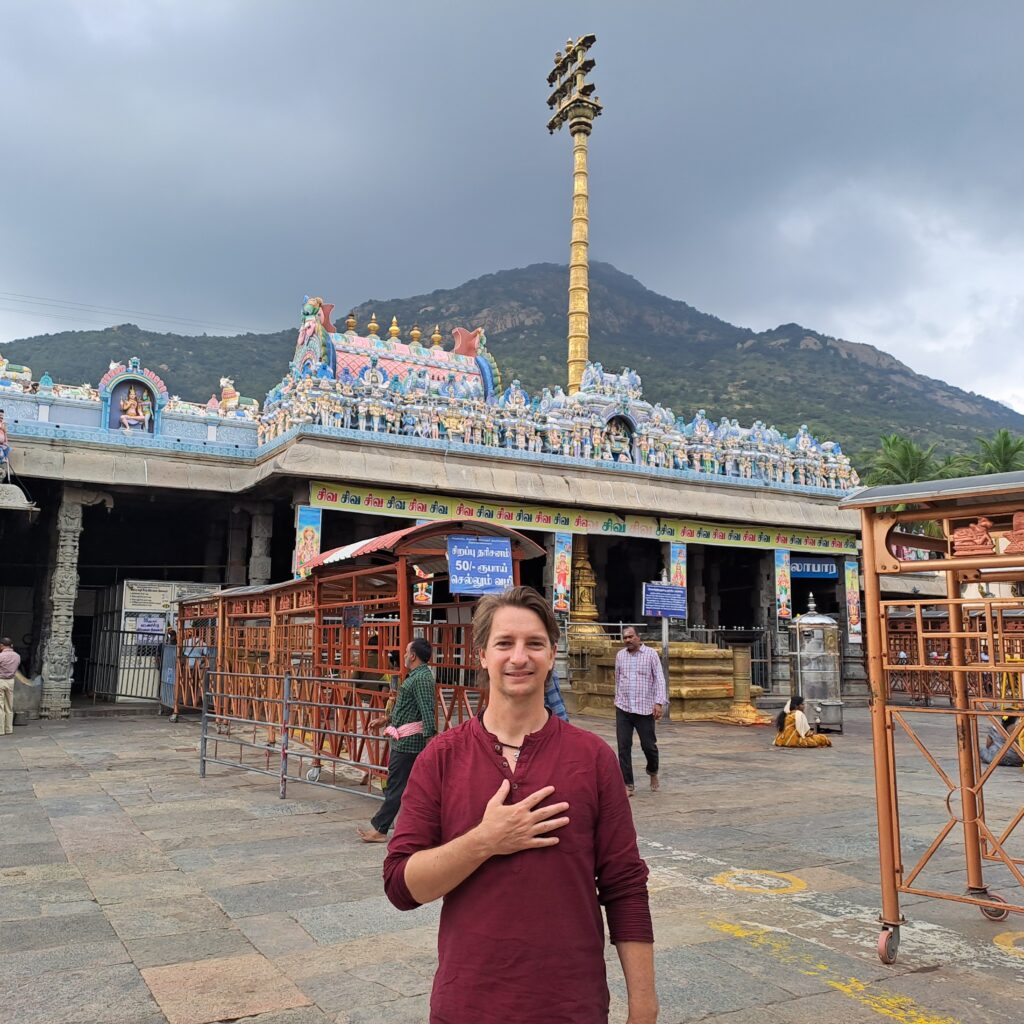
“The Greatest Blessings Shiva Can Give You” Adi Annamalaiyar Temple There is a spiritual thread underlying all of my pilgrimages. None more so than the connection between my Nepal and South India tours. This connection is not something of this world but rather divine. It is the intense presence of Shiva felt throughout India and Nepal. In Nepal, the famous Pashupatinath Temple on the Bagmati River is venerated as one of the holiest abodes of Shiva in the ancient text of the Skanda Purana. Pashupatinath is considered the most important temple complex in all of Nepal. People from all over Nepal come to be cremated on the banks of the Bagmati River in the presence of the Pashupatinath Temple and the famous Shiva lingam that resides within the temple. But Nepal is not just known as a sacred land for Shiva, but also Vajrayana Buddhism. Actually, there is a syncretic thread that flows through the spiritual traditions of the Himalayas and you find this in the esoteric connection between Shaivism and Vajrayana Buddhism. Similar deities, such as through different forms of Bhairava, and philosophical and metaphysical understandings and knowledge. Once you understand this connection, then a deeper realization blooms within you and an appreciation develops in your mind that is truly divine. This realization does not end there, but extends all over the subcontinent. Nowhere more so than South India. No matter if you are in Nepal or in Kanyakumari at the bottom of India, Shiva’s presence is intense and always ready for a heart that is attuned to the divine. The state of Tamil Nadu in the south embodies the divine energy of Shiva like nowhere else. No matter whether it is the magical Kapaleeshwarar Temple in Chennai or the ancient sites of Mahabalipuram, Shiva is there. But the purest essence of Shiva is found in the small little town of Tiruvannamalai, where the Tejo lingam of Shiva manifested as the holy mountain of Arunachala. Just to see the mountain brings tears to one’s eyes and humbles the hardest of hearts. When you are in the presence of Arunachala, you understand why the great 20th century sage Sri Ramana Maharshi headed for Arunachala after his realization. Personally, I’ve had the privilege of being in the presence of Arunachala many times, where surrender to Shiva feels so natural. All projections of the future and clinging to the past vanish in the energy of the eternal now that Arunachala facilitates. It is said in Tiruvannamalai that walking around Arunachala at least once in your life must be done and is the greatest blessing Shiva can give you. I’ve had that privilege many times and those moments are the reason I started my pilgrimages in the first place. Having the opportunity to guide people on these journeys to experience the sacred splendor that I have had the good fortune to do many times is the real blessing of my life. The people you meet and the lifelong friends that eventuate after my pilgrimages is something that is a rare commodity in this world and immeasurable in value. The locations we visit on my pilgrimages are all connected and have a specific divine quality that can only be experienced to be known. That divine connection from Nepal to South India is something I’ve taken with me and embodied, and it is my pleasure to open that space within a pilgrim’s heart to feel the same. If you are interested in my upcoming pilgrimages, then please send me a message below. See you all there. Shanti! Shanti Shanti! Footsteps of Shiva South India Tour 2023 Footsteps of Himayan Yogi Nepal Tour 2024 CONTACT Please enable JavaScript in your browser to complete this form.Please enable JavaScript in your browser to complete this form.Full Name *Email *What is your inquiry? *GeneralConsultationMentorship ProgramsTourCourse RegisterationSponsorshipTitle *Message * SEND
Why I Love Nepal
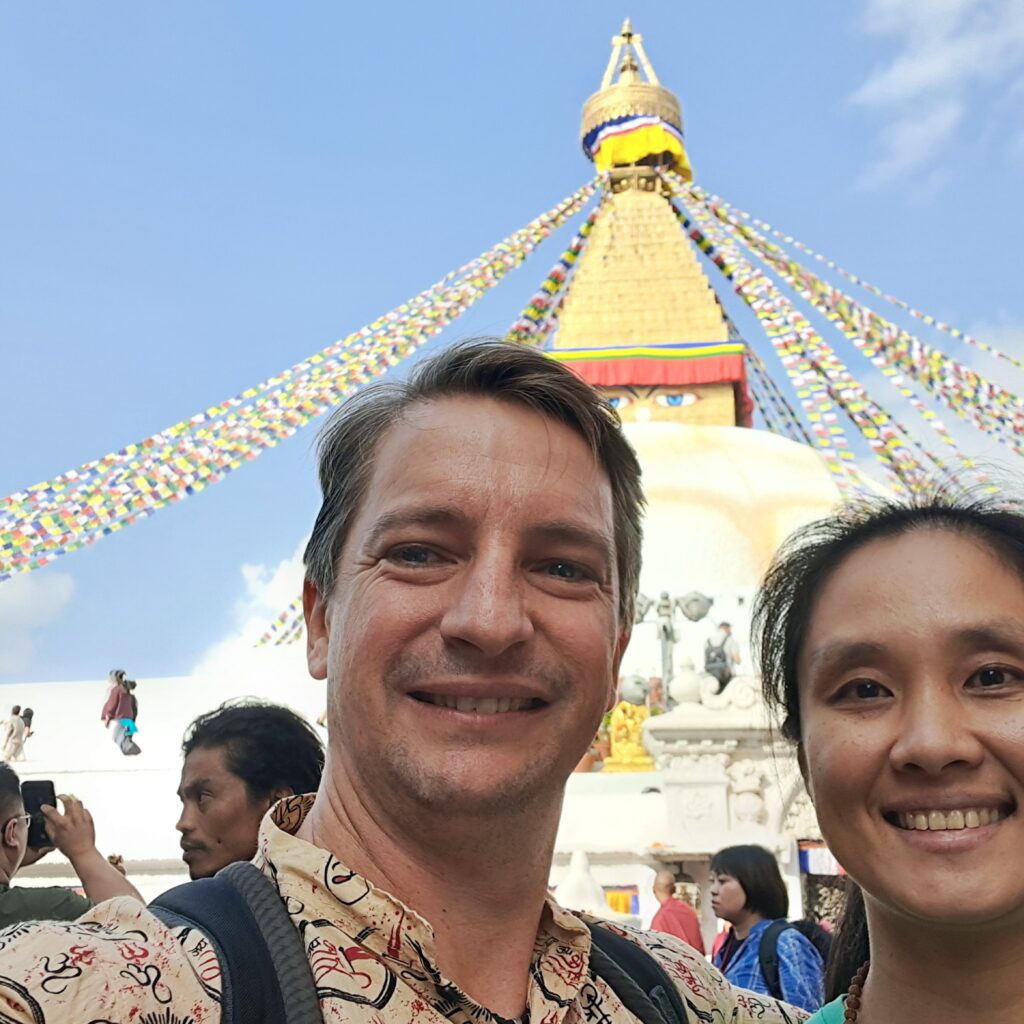
Why I Love Nepal Nepal has been a special place for me throughout my life. After learning Shaivism and Vajrayana Buddhism at a young age, it was important for me to visit the locations where the heart of these traditions are still alive and flourishing. One such place is Nepal, particularly the Kathmandu valley. Two of my greatest Dzogchen teachers, Tulku Urgyen Rinpoche and Dilgo Khyenste Rinpoche, resided in the Kathmandu Valley. So, I was naturally brought to tears when I first visited Schechen Monastery, where Dilgo Khyenste Rinpoche actively gave teachings and also Nagi Gompa Hermitage, where Tulku Urgyen Rinpoche resided and gave teachings on Dzogchen until his death. Along with both of these is the essence of Shiva all throughout the Kathmandu Valley that shines, particularly through the ancient aarti performed every day at the sacred Pashupatinath Temple. Because of all of this and much more, it is a special honor to guide people through Kathmandu Valley so that they too can experience the sacred splendor of the Himalayas. It is a privilege to take people to the places that I love. We explore on my tours Shiva and Buddha’s divine valley of the gods in the Himalayas tracing the footsteps of such masters as Dilgo Khyenste Rinpoche, Tulku Urgyen Rinpoche, Tilopa, Naropa, previous incarnations of the Buddha, and many other sadhus and siddhas of ancient times. No matter whether it is being absorbed in aarti at Pashupatinath, engrossed in the subtle energy of Swayambhu, or in meditation at Namo Buddha, every group I’ve taken to Nepal dives head first into the unknown and embrace the experience. Every time on these tours, people come as strangers and leave as brothers and sisters. The connection is something quite difficult to quantify, but it is there nevertheless. That is why I am excited about taking a new group to Nepal on our tour. If you are interested in joining me on our future Nepal Tour, please send me a message below. CONTACT Please enable JavaScript in your browser to complete this form.Please enable JavaScript in your browser to complete this form.Full Name *Email *What is your inquiry? *GeneralConsultationMentorship ProgramsTourCourse RegisterationSponsorshipTitle *Message * SEND
Samkhya Philosophy Online Course
Samkhya Philosophy Online Course The Hindu Metaphysics of the Soul Four Live Zoom Sessions | Every Saturday from July 11 – August 1, 2026 Samkhya is one of the six classical schools of Hinduism that is lesser known than Yoga and Vedanta and essentially is misunderstood. But Samkhya is imperative to understand if you are going to study the nature of the soul according to Hinduism and, as a result, have an in-depth understanding of its six schools. Samkhya is arguably the most in-depth and important metaphysical system in the world which is misunderstood and mistranslated. Join the Shanti Sangha with Jason Gregory for this mid-year online course on the nature of Samkhya philosophy. In this course Jason will explore the ancient teachings of Samkhya, which is the ancient philosophical system that builds the foundation of the metaphysics of Hinduism. Jason will draw on the seventy-two verses of the ancient Samkhya Karika text to guide the participants to a greater understanding of this wisdom so that we can have a thorough understanding of the metaphysics of the soul. Each class is in a traditional satsang format, which will consist of a 1-hour monologue on the teachings from Jason and then a 30-minute Q&A about these teachings. This will be a great opportunity to explore these teachings together in a place dedicated to the teachings with other sincere spiritual aspirants in the Shanti Sangha. Price and Schedule Cost is $220 USD. Classes will be held at 11:00 AM – 12:30 PM US Eastern time. A Zoom invitation with password will be sent Thursday prior to each weekend. A video recording of the class will be sent to your email address and the link will be available for 30 days. If you are a paid Patreon member, the cost is discounted to $200 USD. To secure your spot, please make payment in full with your name and email address to the following link. You’ll receive a confirmation email within 3 days once you’ve made payment. Course registration is valid until July 8, 2026. Refund Policy After July 8, 2026, payment is nonrefundable. This refund policy is in place because from July 8, 2026 all of the retreat material will have been set for the expected number of attendees. There will be no refund after July 8 as a result. COURSE REGISTRATION
Footsteps of the Shiva South India Tour 2027
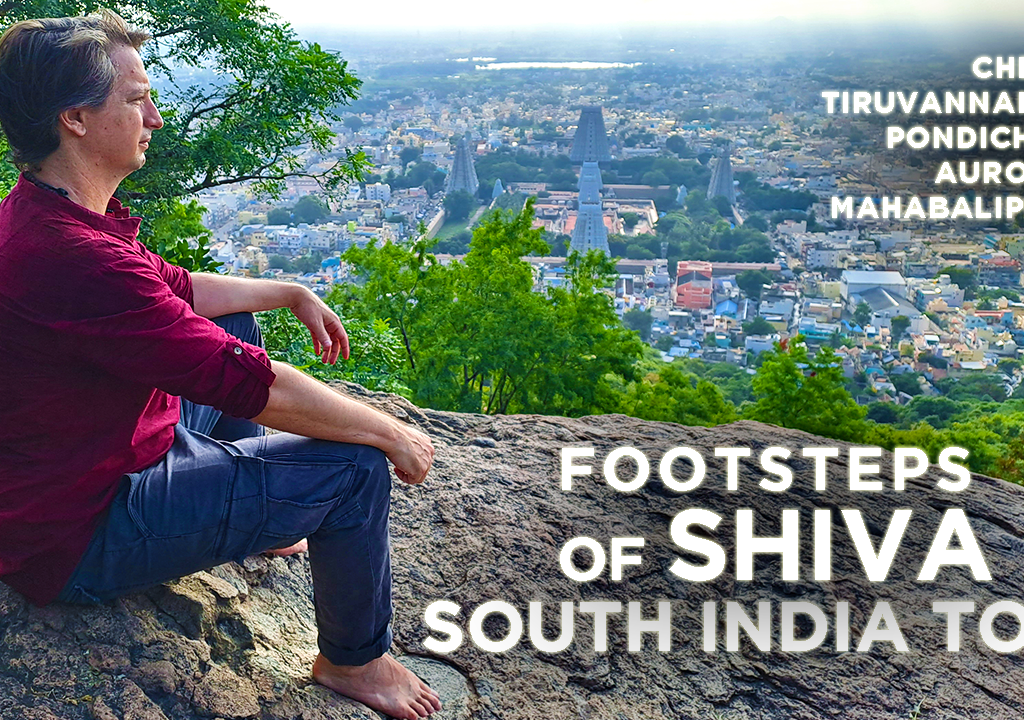
FOOTSTEPS OF SHIVA SOUTH INDIA TOUR THE SACRED YATRA EXPERIENCE with Jason Gregory JANUARY 28 – FEBRUARY 6, 2027 The Sacred Yatra Experience is the ultimate pilgrimage of the spiritual traditions of Asia. The Footsteps of Shiva South India Tour is one of the most unique travel experiences in the world. You can travel with author, philosopher, and teacher Jason Gregory on a mystical tour of South India to explore and trace the footsteps of the great spiritual masters. Get unique insights into Jason’s knowledge of the East and the memory of the masters and sacred places you will visit. Jason wishes to take people to the most sacred places of South India to show that the ancient Eastern spiritual cultures are thriving but can only be experienced by those willing to join him on this pilgrimage of the heart. 1. About our tour to South India Our 10-day itinerary includes visits to the most breathtakingly beautiful and mystical places in South India. We will travel through South India to visit the most important sacred places in Indian history. Most people never get the chance to experience face-to-face the archaic origins and sacred sites of India’s spiritual culture. But on this journey, you will get a once in a lifetime opportunity to actually feel the ancient living spiritual culture that is still thriving in the sacred places you will visit. You will also get the chance to meet real-life mystics and mingle with the beautiful people of India. What is more, during the tour you will take part in private discourses given by Jason Gregory. He will show you the significance of how the great Eastern spiritual traditions can help you live more harmoniously in the modern world. You will begin to understand the deep wisdom the mystics of the East expounded for you to find true happiness and fulfilment in this life. And this is the reason for joining Jason Gregory on his tour of South India to follow in the Footsteps of Shiva. This is a once-in-a-life-time experience! 2. ITINERARY Day 1 – Arrival to Chennai (January 28, 2027) Arrival at Chennai International Airport. A representative of the tour team will welcome guests at the Chennai Airport and transport them to the hotel. After the check-in process at the hotel, guests will have time to rest and recuperate before a day of exploring Chennai the following day. Day 2 – Chennai (January 29) Exploring Chennai. Chennai (formerly known as Madras) is one of the most famous cities in India for the arts and spirituality. Chennai was an essential part of the evolution and revitalization of Vedanta into global consciousness. The great Swami Vivekananda realized this city’s importance within India and, as a consequence, established one of the most famous Ramakrishna Math Temples in the world. Chennai is also famous for some of the most breathtaking temples in India, with unique Dravidian architecture. One such temple is the Kapaleeshwarar Temple, a temple dedicated to Shiva. On Day 2, we will visit the Kapaleeshwarar Temple, the Ramakrishna Math Temple, the Vivekananda House, and also mingle with the locals in the afternoon at the Marina Beach markets so that you can get a taste of the strong community within India. Day 3 – Tiruvannamalai (January 30) Travelling to Tiruvannamalai. Tiruvannmalai is considered one of the most sacred places on Earth. It has the ability to transform one’s life. It is known as the City of Enlightenment for that very reason. It has been the home of sages, sadhus, and yogis for thousands of years. Tiruvannamalai is home to the holy mountain Arunachala, which is thought to be an incarnation of Shiva. Arunachala is what drew the 20th century sage Ramana Maharshi to this little Indian town, where he remained silent for 7 years up on the holy mountain in meditation. During his life on the slopes and at the foot of Arunachala, disciples were attracted to his immense presence, and an ashram was built around him, the famous Sri Ramana Asramam. It was here that Paul Brunton had his famous encounter with the Maharshi and which consequently led to his international bestseller In Search of Secret India. This Hindu culture has never left this place, where you find sadhus descend on Tiruvannamalai every day, renouncing the world to be at the foot of Arunachala and to also spend time in meditation at the Arunachaleswarar Temple (Temple of Shiva). On Day 3, we will visit the Sri Ramana Ashram after lunch, and then we will visit the famous Girivalam Path to visit temples and be in the presence of sadhus. Day 4 – Tiruvannamalai (January 31) Early in the morning on day 4, we will go to Sri Ramana Ashram to observe Puja (Hindu ritual worship) and also meditate in the silence of this sacred space. We will then walk up to Skanda Ashram and Virupaksha Cave on Arunachala, where Sri Ramana Maharshi spent many years in silence. We will practice meditation in both places. In the afternoon, we will tour the city of Tiruvannamalai to get acquainted with the City of Enlightenment. Later in the day, we will again visit the famous Girivalam Path to visit temples and be in the presence of sadhus. Day 5 – Tiruvannamalai (February 1) We will rise early again on day 5 to meditate in Sri Ramana Ashram. After breakfast, we will visit Arunachaleswarar Temple (Temple of Shiva) and explore its magnificent architecture and mythology. After lunch, we will visit the oldest temple in Tiruvannamalai, Adi Annamalai Temple. Day 6 – Tiruvannamalai (February 2) Arunachala Blessing Day. Day 6 is a very special day. We will get the once in a lifetime opportunity to circumambulate around Arunachala, which is important for any pilgrims coming to Tiruvannamalai because it is believed one gets blessings directly from Shiva, absolving one’s karma. We will slowly walk the 13 kilometers around Arunachala, taking our time to soak in this life-changing day. Day 7
Epilogue – Ladakh Tour 2025
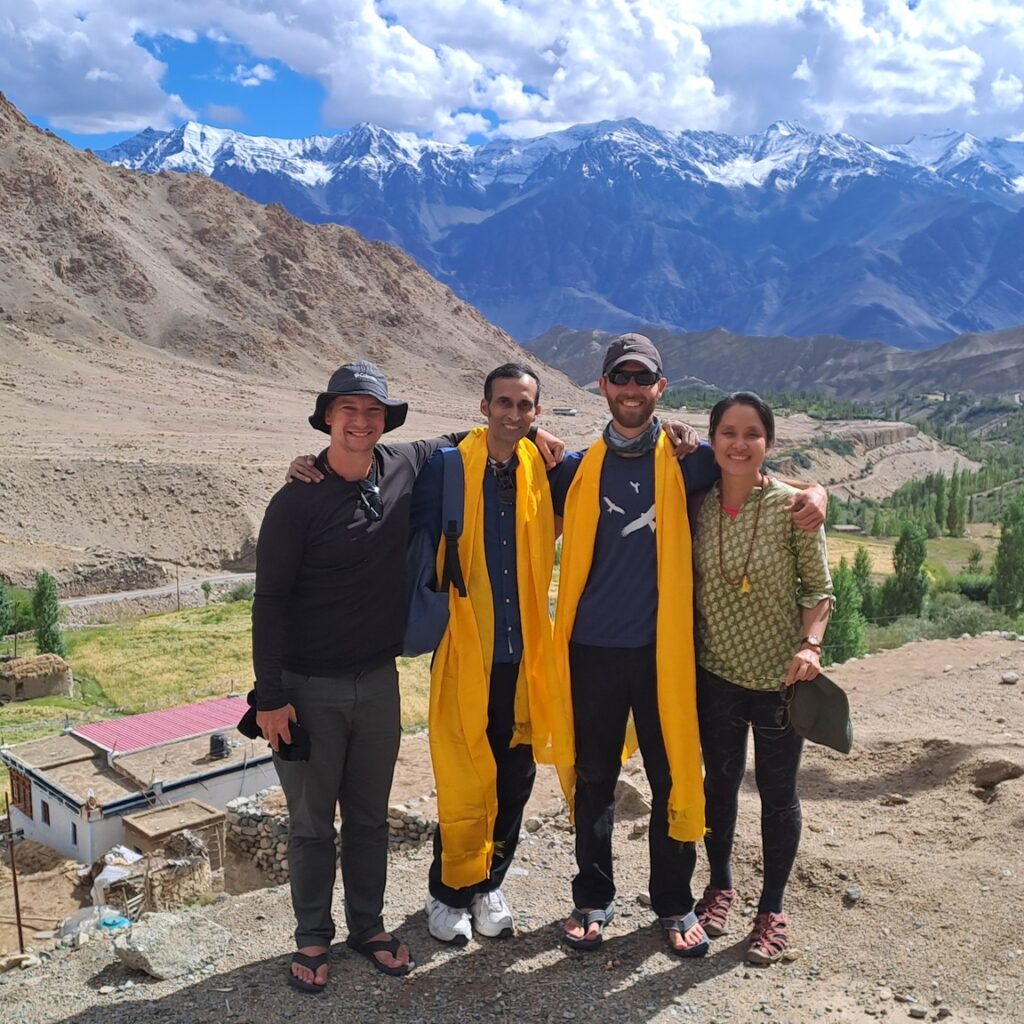
Epilogue – Footsteps of the Mahasiddhas Ladakh Tour 2025 – The Footsteps of the Mahasiddhas Ladakh Tour was truly a once in a lifetime adventure that may never happen again for many reasons. First, it was one of the hardest to organize due to Ladakh’s proximity and the weather, but in saying that, it was still one of the most rewarding tours. The second obstacle with the Ladakh tour was getting people to commit to the tour due to concerns over the high altitude. These concerns aren’t invalid but can be a concern one overthinks about because the possibility of being severely impacted by the altitude is very low. So, as a result, we initially had a good number of people interested, but eventually most of them pulled out. Thankfully, we had two past participants who wanted to come, Ross and Srinivasan. Ordinarily, with only two participants, the tour wouldn’t happen, but both gentlemen came to the Nepal tour last year, and they have become great friends, and so we really just wanted to introduce Ladakh to anyone, so we went ahead with the tour. Amazingly, Srinivasan and Ross were not impacted by the altitude. They were both straight off the plane and into action. Gayoung and I were so excited to show both the beauty and magic of the Himalayas in Ladakh. The ancient Vajrayana Buddhist monasteries in Ladakh are some of the most picturesque in the world. So, it was an absolute pleasure to meditate as a group in some of the most remote monasteries in the world. The chance to trace the footsteps of the great Mahasiddhas, such as Padmasambhava, is something you can’t quite quantify, but it means something beyond words and builds a meaning in one’s soul that we take with us beyond this life. We visited the monasteries of Spituk, Alchi, Likir, Thiksey, Hemis, Chemrey, Takthok, and Diskit. All of these monasteries are significant in the evolution of Vajrayana Buddhism. For example, the cave monastery of Takthok is especially important because it was the very cave that Padmasambhava meditated and lived in for three years on his way from Oddiyana to Tibet, where he established Buddhism in its Himalayan form. There is a stillness in this cave that is hard to replicate. These sorts of experiences on a pilgrimage have a resonance that reverberates in the heart of the pilgrims that we take with us into the future but also connects us on a deeper level for life. This is only one of many reasons why pilgrimage is an important spiritual practice. Unfortunately, pilgrimage is a lost spiritual practice in an increasingly disconnected world. But for those with their perception cleansed of such divisive distortions, then the pilgrimage is a metaphysical glue that bounds the participants and, as a result, becomes a microcosm of what the world could and should be. Ladakh, like all of our pilgrimages, is just that, a microcosm of what the world could and should be, and that is why we are dedicated to showing people the true essence of oneness in all of our hearts through a journey of discovery together as one moving organism. No words can describe the feeling and power of a pilgrimage with people who are pure of heart and dedicated to the spiritual path. Gayoung and I are just so thankful that Srinivasan and Ross were brave enough to join us on a heartfelt journey together where we strengthened our bond even more from our Nepal adventure in 2024. We love you both and look forward to deepening our connection in our ongoing pilgrimage through life.
The Dissolution of Identity

The Dissolution of Identity To be free in this life, we must unlearn what we’ve gained and relearn what we’ve lost. What you will read about in the following chapters is a relearning of the natural way that has been eclipsed by what we’ve gained, the process of socialization. Then, and only then, will we become a bona fide zhenren (genuine person/Taoist sage). This means, though, that we have to examine and dismantle our identity as it is the byproduct of socialization. This is one of the most uncomfortable processes, but a necessary evil on the spiritual path, especially in Taoism. One of the common misconceptions of Taoism in the West is that it is a path solely focused on flow and the art of living without any need for getting our hands dirty. This view is a very airy-fairy perspective of Taoism. It excludes the very thing that needs to dissolve to be in flow and embody the art of living—identity. With a strong sense of identity, none of the Taoist principles can be lived. Some of these inane views of Taoism come from incorrect translations and other translations with no explanation. For example, someone will read in the Tao Te Ching about unlearning and think it is about unlearning what they’ve learned, such as education and also couple that with an unlearning of trying to know the Tao. And both may be necessary, and in part true, but they are not the whole puzzle. What unlearning really means in the Tao Te Ching is the unlearning of your identity, that thing within us that is the accumulative product of socialization. As discussed in previous chapters, the identity or ego acts as a fundamental blockage to the fundamental forces and flow of Tao. The fear people have concerning the dissolution of identity is that they incorrectly believe they won’t function without an identity, as if there is nothing intrinsically there without the ego. This is simply not true and something you will learn later in this book. People in the modern world, and especially Westerners, are often more favorable toward Taoism and Yoga, but they are more suspicious of Advaita Vedanta and Buddhism because of the inaccurate belief that the underlying premise of the dissolution of self of the latter two traditions doesn’t exist in the former two. This is simply untrue. To be sure, the dissolution of the ego, self, or identity is the common principle and goal of many Eastern spiritual traditions. The methods and philosophy to achieve that end are different among the traditions and explained differently, but the principle is the same. Achieving such a dissolution is referred to in Hinduism and Buddhism as enlightenment but worded differently when referring to the sage in Taoism, as we discover with the word zhenren. Nevertheless, there is a natural state of being that we fundamentally are but has been suppressed. Essentially, we are all inherently enlightened but we’ve forgotten and must unlearn to realize this truth. This fundamental truth of innate enlightenment within the Eastern spiritual traditions I sum up with one phrase: Enlightenment is the dissolution of “I” and the reidentification with the ultimate reality. The ultimate reality, as discussed, is known as either Brahman in Advaita Vedanta or Tao in Taoism. The reidentification with the ultimate reality in Advaita Vedanta is known as the realization that Atman (undifferentiated consciousness) within all is Brahman. You are one with Brahman as Brahman. Likewise, in Taoism, reidentification is the result of letting go of identity and merging as one with the river of Tao. To merge with the river of Tao requires a complete dissolution of identity. To express our inherent virtue (te) according to our unique organic pattern (li), we must stop fighting the world according to our identity and let go of it so that the river’s power can become our power. We fight the current of the river of Tao because we see the world through the veil of identity. We measure the reality according to our identity and incorrectly believe that’s the way the world is. It is not. It is only the way your identity perceives it, and then all sorts of narratives are created, leading to conflict and confusion. Paradoxically, if we are serious about world peace, then the one who yearns for peace must disappear. World peace can never be attainable through personas created by the socialization process. So the conflict we are constantly trying to resolve can never be rectified if the solution is filtered through identity, which is inherently flawed by self-interest and conditioning. Our innate nature knows no form of conflict because it is naturally harmonious and one with the river. Our nature was warped due to socialization and, as a result, the accumulation of a separate isolated self was born. The destruction of our nature is nothing new. Since the birth of agrarian cultures and large-scale societies, our nature has been distorted. Chuang-tzu warned us about socialization almost twenty-five hundred years ago due to the increasing tyranny of Confucianism. The Story of Hundun In the very last part of the inner chapters of the Chuang-tzu text, there is an extremely important story that encapsulates the whole Taoist philosophy and view of identity and social conditioning. This is the story of Hundun. The word Hundun is known in its Cantonese variation as Wonton, a famous mixed dumpling that you may have eaten. But Hundun in the Chuang-tzu is no mixed dumpling, but rather some primordial state before the world of forms came into manifestation. In ancient China, Hundun is a type of mythological being that represents the original state of the universe. Hundun is an indistinct primordial being without any features or qualities, similar to the Greek notion of chaos, the qualityless state of Nirguna Brahman in Advaita Vedanta, and the original state of Tao in wu chi. Hundun—as with chaos, Nirguna Brahman, and wu chi—is the cosmogenic idea that the
Reclaiming Taoism
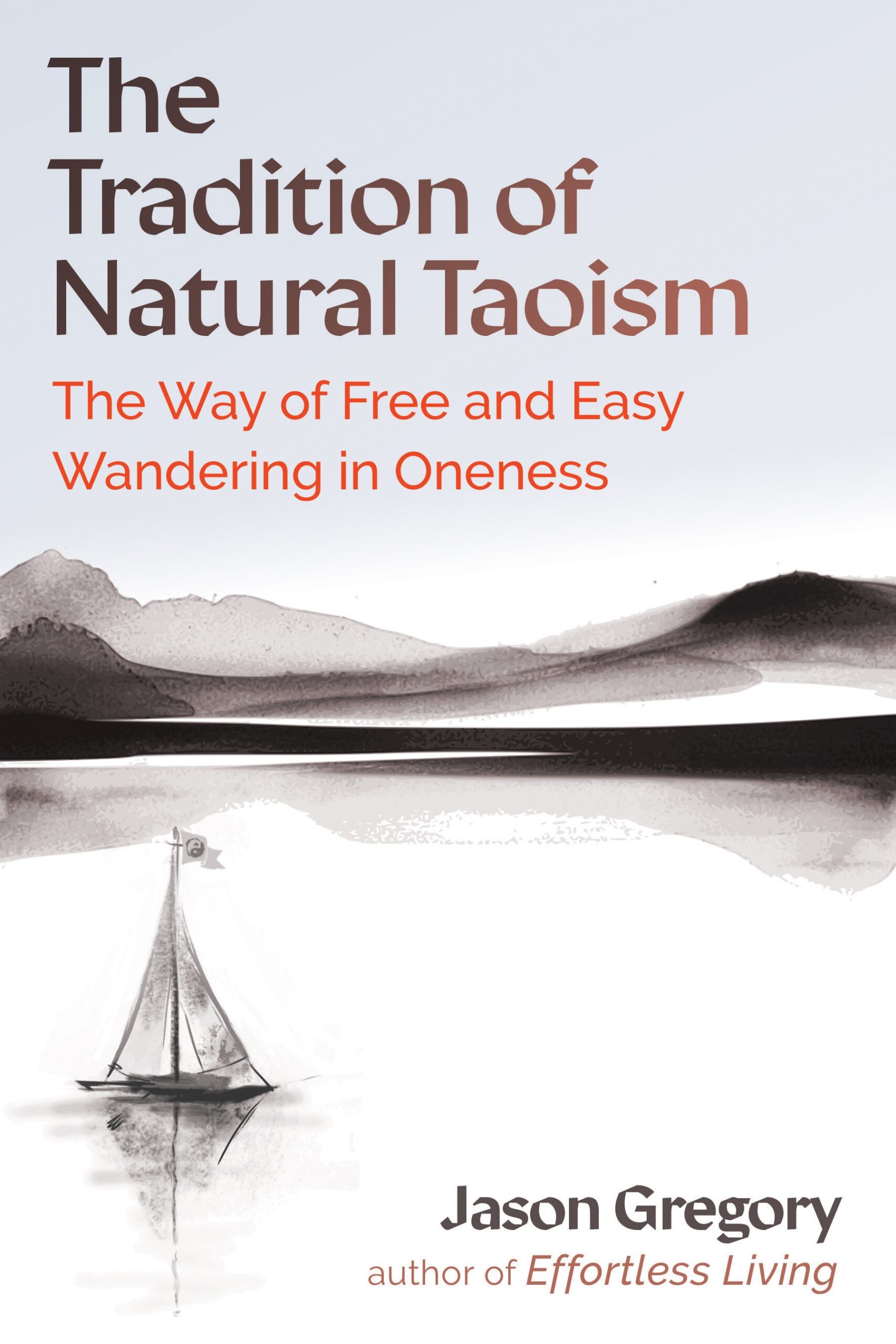
Reclaiming Taoism Taoism is essentially a philosophy based on the way of nature. But even that statement on its own can be misinterpreted due to one’s own personal, social, cultural, or religious understanding of the way of nature. For Taoism, even though this definition seems self-explanatory, it is complex to understand and even more difficult to live by. This entire book will explain what it truly means to be in accord with and to follow the way of nature, the Tao. But before that, we truly need to comprehend that Taoism is essentially a natural philosophy. In the age of information saturation, Taoism, like much else, has fallen victim to misunderstanding, misinterpretation, and misinformation. Its nature is essentially mysterious, so if one has not studied Taoist philosophy extensively, a warped view of the tradition eventuates that, unfortunately, influences other people not schooled in Taoism. It is a constant cycle of misinformation, which has been ramped up since the advent and increased popularity of social media platforms such as YouTube. These platforms perpetuate misinformation about Taoism, especially that based on incorrect translations of the Tao Te Ching and Chuang-tzu texts. Unfortunately, a lot of these incorrect translations are the most popular versions of these texts—particularly of the Tao Te Ching. These versions have been stripped of their original meaning to make sense to a predominantly Western audience with certain cultural sensibilities. They are easier to follow and poetic for Western minds. Many people enjoy reading them because they relate to us in the here and now. Even I enjoy reading them occasionally. But at the end of the day, they are not correct and distort the original meaning and intent of the Taoist texts. The most accurate translations are vague and mysterious to the untrained mind. They require deeper contemplation and understanding. They require us to understand the real nuanced meaning of each line from what was truly written in Chinese. Each chapter and rereading elicit a new layer of understanding. We cannot honestly come to a conclusion on those texts after one reading. A deeper inquiry is needed. One that cannot happen in short spurts like five-to-ten-minute YouTube videos based on unclear translations. If you are serious about Taoism, then it is imperative to understand its genuine essence and what it truly is. A Need for Structure Though it may seem counterintuitive to the way of Taoism, there is a growing need for structure and clarity on what Taoism is and, essentially, what it means to be Taoist. Despite the lucid, effortless nature of Taoism, we live in an age where some framework is needed to avoid a complete disfiguration of the tradition. It is not just about knowing what particular aspects of Taoism are or even experiencing them, but rather a complete understanding of the tradition is required that will transform your psychology and worldview. Based on the way of the Tao, many different systems of cultivation were created over the thousands of years since the time of the great Taoist sages Lao-tzu and Chuang-tzu (369–286 BCE) in China’s Warring States period. Most notable are the cultivation methods of martial arts and Traditional Chinese Medicine (TCM) based on the holistic philosophy of Taoism. More precisely, these two branches are known in Chinese as Neidan, internal alchemy, and Waidan, external alchemy. The internal alchemy of Neidan is cultivated through the well-known martial and nonmartial arts spiritual practices of t’ai chi ch’uan (commonly known as t’ai chi), qi gong, baguazhang, xingyiquan, liuhebafa, and daoyin, which are all part of what is known as Nei Gong. The external alchemy of Waidan is practiced through herbal elixirs, specific foods, and other physiological practices all related to a holistic view of the human body and mind. Both Neidan and Waidan are based on the tenets of holism, which is the essence of Taoism, and a fundamental understanding of oneness that we will explore throughout this book. Such traditions and lineages stemming from Taoist philosophy have developed and been refined for thousands of years. Personally, I am actively engaged in both Neidan and Waidan, and I can tell you from experience that if both are informed by their original philosophy of Taoism, then they will transform your life. A common misconception is a lot of people think if they practice t’ai chi ch’uan, for example, that this makes them a Taoist. Nothing could be further from the truth. That would be like saying anyone who practices hatha yoga is a Hindu. Hatha yoga is a small part of Hinduism, but you don’t have to practice hatha yoga to be Hindu. Likewise, you don’t have to practice t’ai chi ch’uan, qi gong, or Waidan to be Taoist. Will they deepen your understanding and experience of Tao? Yes, of course, especially if they are informed by Taoist philosophy. But are they necessary to follow the Tao? No. Taoism is essentially an attitude, behavior, and worldview shaped by nature and not human socialization. Some people have an inherent aptitude for Taoism, and others need cultivation. Both depend on various factors: your genetic blueprint, your past life karma, your upbringing, culture, and religious indoctrination. Nevertheless, the Tao is ever-present, immanent within all experience, and at the same time transcends all experience. There is no one way to align yourself with the irreducible essence of Tao, though we could say Neidan, meditation practices, simplifying your life, and other practices are all effective methods. But, keep in mind, if you don’t understand the philosophy of Taoism, then no matter how much you practice meditation, for example, the experience and depth of the Tao within your being will not be realized. Taoism requires a complete transformation via a dedication to unlearning the socialization we’ve all endured, which is not an easy feat. Taoism is a technology for deprogramming our minds from socialization so that we can finally return to our original natural state. Returning to our basic disposition can, ironically, be one of the hardest things
Reclaiming Self-Knowledge Online Retreat
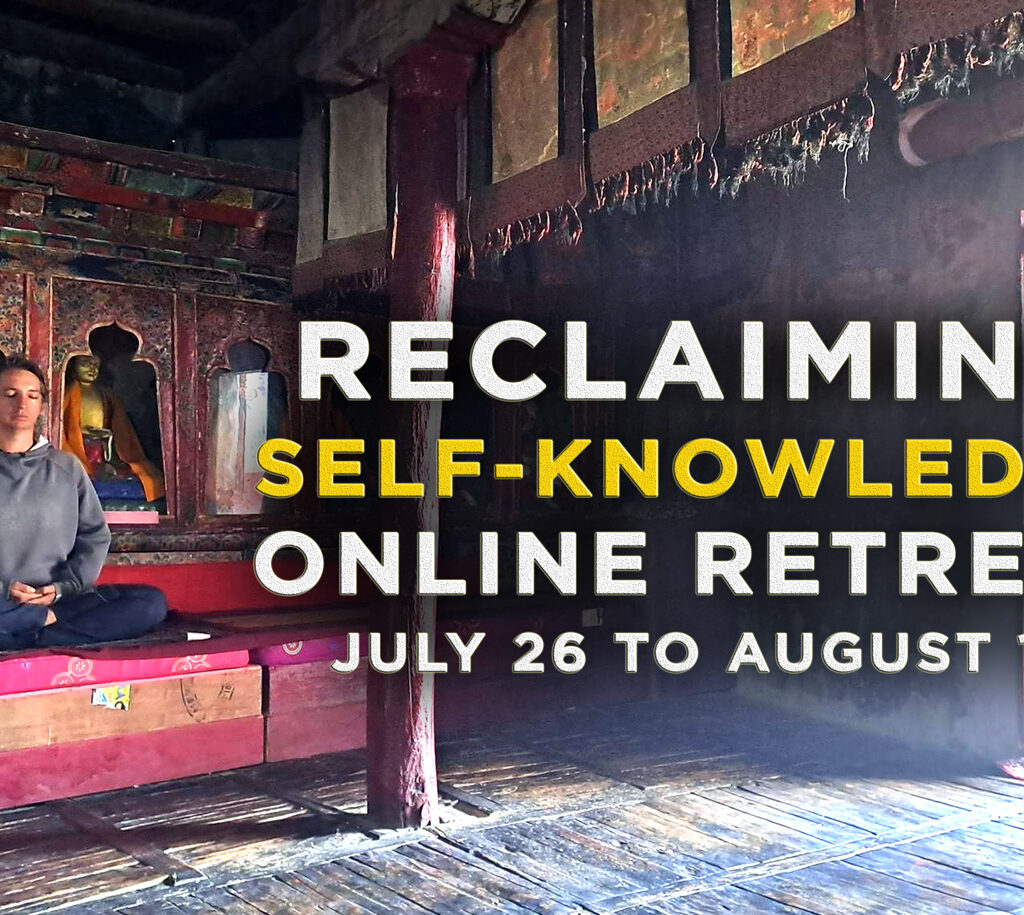
Reclaiming Self-Knowledge Online Retreat Four Live Zoom Sessions | Every Saturday from July 26 – August 16 Join the Shanti Sangha with Jason Gregory for this mid-year online retreat on the nature of Self-Knowledge. In this retreat we will explore the ancient teachings of Atmabodha (Self-Knowledge), the philosophy of Nondualistic Vedanta. Jason will draw on the sixty-eight verses of the Atmabodha text to guide the participants to a greater understanding of this wisdom so that we can all reclaim Self-Knowledge. Each class is in a traditional satsang format which will consist of a 1-hour monologue on the teachings from Jason and then a 30-minute Q&A about these teachings. This will be a great opportunity to explore these teachings together in a place dedicated to the teachings with other sincere spiritual aspirants in the Shanti Sangha. Price and Schedule Cost is $200 USD. Classes will be held at 11:00 AM – 12:30 PM US Eastern time. A Zoom invitation with password will be sent Thursday prior to each weekend. A video recording of the class will be sent to your email address and the link will be available for 30 days. If you are a paid Patreon member, the cost is discounted to $180 USD. To secure your spot, please make payment in full with your name and email address to the following link. You’ll receive a confirmation email within 3 days once you’ve made payment. Course registration is valid until July 23, 2025. Refund Policy After July 23, 2025, payment is nonrefundable. This refund policy is in place because from July 23, 2025 all of the retreat material will have been set for the expected number of attendees. There will be no refund after July 23 as a result. COURSE REGISTERATION